How to Use a Pocket Notebook for Personal Reflection
Use a pocket notebook for personal reflection to capture a passing moment, revisit it with curiosity, and keep notes private without demanding daily entries.
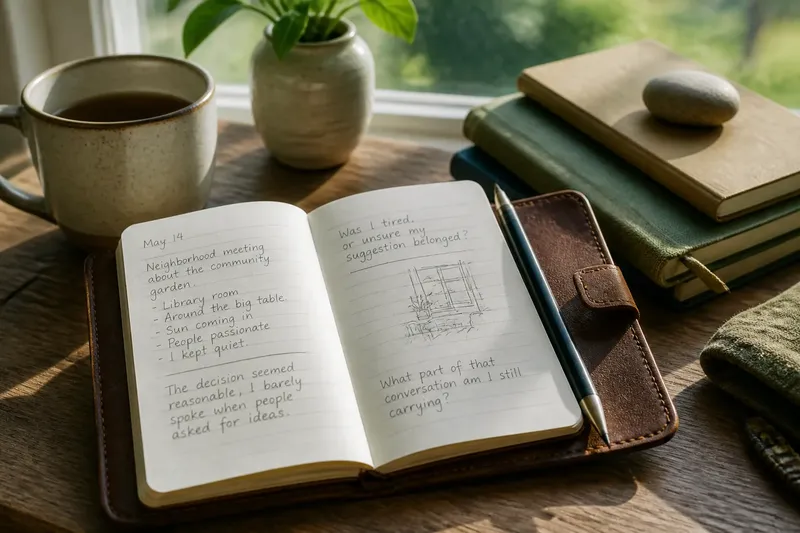
A pocket notebook for personal reflection can preserve a thought that might otherwise vanish between errands. A few concrete details and an open question are often enough to revisit what happened without turning a first impression into a verdict.
Choose a notebook that is easy to reopen
Pick a notebook small enough to carry comfortably and plain enough that you do not feel obliged to make it impressive. A sewn notebook, a slim spiral pad, or folded sheets tucked into a cover can all serve. The useful choice is the one you can open without arranging a special setting.
Lined pages can steady handwriting; blank pages leave room for a sketch or a rough map of a conversation. A pencil is easy to revise, while a pen can make a note feel more definite. You do not need a dedicated journal or accessories before you begin.
Give the notebook a home when you are not carrying it, such as a familiar shelf or desk drawer. Carrying it is an option, not a rule. If it is not with you, you can jot a thought on scrap paper and transfer it later—or let it go.
Capture the scene before explaining it
When something stays with you, record the scene before deciding what it means. Include details that will help you recognize it later: where you were, what was said, what you noticed in your body, or what interrupted your attention. A few concrete words can be more useful than a polished account.
Then add a question that leaves room for uncertainty. “What part of that conversation am I still carrying?” invites observation. “Why did I handle it badly?” has already delivered a verdict. You can also note what you expected and what actually caught your attention.
Imagine you leave a neighborhood meeting unsettled after a discussion about a shared garden. You write: “The decision seemed reasonable; I barely spoke when people asked for ideas.” Then you add, “Was I tired, or unsure my suggestion belonged?” The starting point is the meeting and your silence; the action is recording the scene and an open question; the result is a specific thought you can revisit without claiming to know why you stayed quiet.
Keep the record private and forgiving
A private notebook can hold unfinished thoughts because it does not have to persuade an audience. Use shorthand, crossed-out phrases, arrows, or a sketch that makes sense only to you. An entry does not need to become a lesson, a plan, or a statement about who you are.
Think carefully about what the page needs to contain. If naming another person adds no value, use a general description instead. A paper notebook can be misplaced, so store it somewhere you consider appropriate and leave out details that could expose someone’s confidence or put you at risk.
Let gaps remain gaps. A missed day does not create a debt, and an unfinished entry does not need repair. The purpose is to make returning possible, not to produce a complete account of your life.
Revisit old pages without scoring yourself
Choose an occasional quiet moment to read a few older entries. Open to a page at random or revisit one that still feels vivid. Notice what you recorded then and what you understand differently now. A past note shows what you noticed at the time; it is not a final judgment on your character.
Look for changes in emphasis rather than totals. A worry that once filled a page may now appear as one concern among several; a small pleasure may be easier to name. If the same question returns, that is information to consider, not automatic evidence that you have failed to progress.
If an old entry feels harsh, add a note beside it rather than rewriting it as though your earlier self were an error. Record what you know now, or what remains unclear. Keeping both perspectives visible can be more honest than editing the past into today’s language.
Let the notebook’s form change
Notice which kinds of notes help you think. You might prefer a short scene and a question, a few lines of dialogue, or a small drawing. Change the form when the subject changes; no single prompt has to serve every entry.
You can also choose what not to preserve. Leave out a detail that feels too private, unhelpful, or raw to revisit. If you no longer want to keep a page, remove or discard it in a way that feels appropriate. The point is not to archive everything, but to keep a record that supports a thoughtful return.
What should you know about pocket notebook reflection?
How often should I write in a pocket notebook?
Write when a moment seems worth revisiting; there is no required frequency. The notebook can still be useful when several pages remain blank between entries.
What can I write when nothing feels important?
Record a plain observation, such as a detail from the walk home or a sentence that stayed with you. If nothing comes to mind, closing the notebook is a reasonable choice.
Is a paper notebook better than a phone note?
Paper offers a contained place to write and browse, while a phone may be easier to carry or search. Choose the format that makes private, unhurried reflection accessible to you.
How can I keep personal notes private?
Store the notebook somewhere you control and omit identifying details that are not needed for your reflection. If the subject is highly sensitive, consider whether paper is an appropriate place to keep it.
Use a pocket notebook for personal reflection without forcing an answer
Write enough to recognize the moment, leave a question open, and return when you have a different perspective. If rereading a page brings no useful insight, you can close the notebook and move on; reflection is an invitation to look again, not an obligation to resolve every thought.