An Unclaimed Hour for a Creative Project
An unclaimed hour for a creative project works best when you choose one finishable task, prepare its materials, and leave a clear next step.
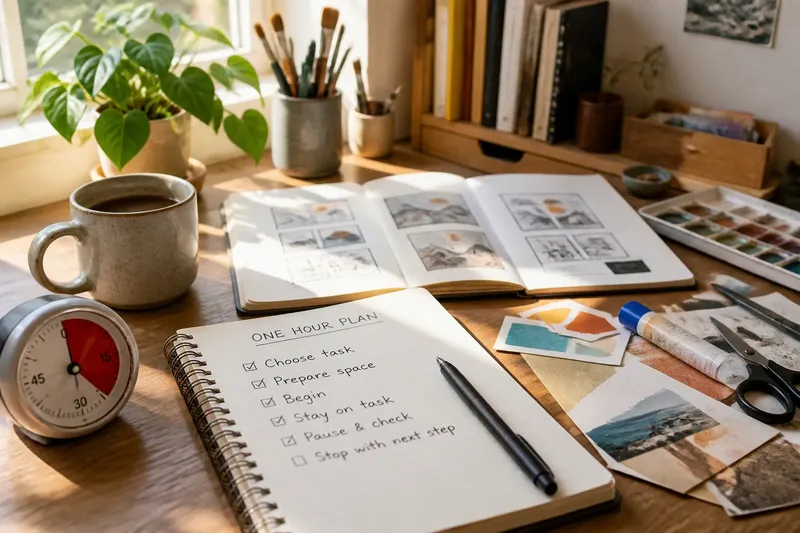
An unclaimed hour for a creative project is easier to use when you decide what “finished” means before you begin. Instead of aiming to complete a novel, painting, song, or craft project, choose a small piece you can bring to a visible stopping point. That choice gives the hour a shape without requiring you to predict how much energy or concentration you will have.
The aim is not to fill every minute. It is to make a deliberate opening for creative work, then leave the project in a state you can return to. These considerations can help you spend the hour on the work itself rather than on deciding what the work should be.
1. Choose a task with a visible finish
A large project usually contains several kinds of work: generating ideas, making a rough draft, revising, gathering materials, and preparing something to share. For one open hour, select just one kind of work and make its endpoint observable. “Work on my short story” is difficult to finish; “write the scene where the character finds the letter” gives you a passage you can recognize when it exists.
A finishable task is not necessarily easy or polished. It should simply have boundaries you can see. A ceramicist might shape one small bowl rather than complete a set. A musician might mark the chord changes in one section rather than arrange an entire song. A sketcher might make a page of thumbnail compositions rather than finish an illustration.
Say you have an unfinished poster and an hour before an appointment. You decide to create three rough layouts using the existing title and image, rather than complete the poster. At the end, the layouts give you something concrete to compare, even if none is ready to publish.
Write the task as a short sentence that names an action and an endpoint. If you cannot tell when it is done, narrow it until you can.
2. Match the task to the hour you actually have
An open hour on a quiet morning is different from an hour squeezed between errands. The clock gives you a limit, but your available attention also depends on the conditions around it: whether you need to leave on time, whether your materials are ready, and whether interruptions are likely. Treat these as part of the plan, not as failures of concentration.
For a calm stretch, you may choose a task that needs sustained attention, such as revising a scene or blocking in a drawing. If the hour is likely to be broken up, choose work that tolerates pauses: sorting reference images, labeling audio takes, or making a set of color swatches. This is not a judgment about which kind of work matters more. It is a way to give the task a fair chance in the circumstances you have.
Leave room for ordinary transitions. You may need to clear a table, open a file, or put away wet materials before moving on. A plan that assigns every minute to making can become brittle as soon as setup takes longer than expected.
Before choosing the task, ask what kind of attention this particular hour can support.
3. Prepare the smallest useful workspace
Preparation should remove avoidable searching, not become a separate project. Gather the tools needed for the task and leave other materials out of reach or out of sight. For writing, that might mean opening the draft and the notes for one scene. For collage, it might mean placing the selected paper, scissors, adhesive, and backing board on the work surface.
A smaller workspace can make the next action more obvious. If your desk holds several unrelated projects, move only the items that compete with the task you chose. You do not need to redesign the room or sort every supply. The point is to make it easier to start the specific work in front of you.
It can also help to prepare a simple fallback action. If you find that you cannot continue the main task, you might mark questions in the draft, clean a brush, or label the files you will need later. Choose something that still belongs to the project, rather than switching to an unrelated chore that happens to be nearby.
Put the first tool or file where your hand or attention will naturally go when the hour begins.
4. Begin with an action, not a verdict
Creative work can invite early judgments: the paragraph sounds wrong, the melody is dull, or the drawing does not resemble the idea. Those reactions may eventually help with revision, but they can interrupt the first attempt if they arrive before there is enough material to assess. Start with an action that produces something you can respond to.
For a writer, that could be drafting the exchange without polishing it. For a photographer planning a series, it could be listing possible subjects in one place. For a painter, it could be testing a few colors on scrap paper before touching the main surface. These actions are not commitments to keep every result; they create material for a later decision.
If the first mark feels difficult, make the task smaller again. Write one line of dialogue, place one shape, or record one melody fragment. A modest start can give your attention a specific object to work on, whereas a broad ambition often leaves you negotiating with the whole project.
Give the work a first move that can be done without deciding whether it is good.
5. Keep the session from expanding sideways
Once you begin, related tasks may appear: research a new tool, reorganize your reference folder, revisit the project’s concept, or check how other people have handled a similar subject. Some of those tasks may be useful, but they can also replace the small piece of making you chose for the hour.
When a side question arises, write it on a scrap of paper or in a separate note and return to the task. This gives the question a place without asking you to solve it immediately. If the question blocks the work—for instance, you cannot draw the object because you do not know its shape—make a brief, specific decision about what information you need, then keep the research bounded to that need.
Attention is easier to maintain when the next action remains in view. Keep your task sentence nearby, especially if the project has many tempting branches. If the work changes direction for a clear reason, revise the sentence rather than silently drifting into a different project.
Park interesting detours somewhere you can find them after the hour.
6. Use a natural pause to check the task
A pause can help you notice whether the work still fits the time and conditions. It need not be a formal review. When you finish a paragraph, mix a new color, or reach the end of a music phrase, look at what is already there and ask a narrow question: what remains for this task to count as finished?
If the answer is still manageable, continue. If the task has grown, choose a smaller endpoint that preserves the useful part of the work. A collection of notes might become a short list of the strongest ideas; a full revision might become a pass over one page. Adjusting the endpoint is different from abandoning the project. It lets you respond to the actual session instead of forcing the original plan to fit at any cost.
Try not to use a pause to rate your talent or decide whether the entire project is worthwhile. Those questions reach beyond the hour and can be difficult to answer from a single unfinished piece. Focus instead on the next visible action.
At a pause, assess the task’s size, not your worth as a maker.
7. Leave a clear landing point
Stopping is part of the session, especially when you intend to return to the project. Save or label the work in a way that makes its current state easy to recognize. A draft might end with a note about the scene’s unresolved question; a sketchbook page might include the color or reference you want to revisit. Keep the note brief enough that it does not become another assignment.
Choose a next action that begins where you stopped. “Continue the illustration” is broad, while “compare the two thumbnail layouts and enlarge one” points toward a usable start. This note helps preserve the thread of the work without requiring you to decide the entire future of the project.
Take care of materials that need attention before you leave the workspace. For anything involving special handling, follow the product label or the maker’s instructions. Otherwise, a simple reset—putting tools together and keeping the active piece accessible—can make returning feel less like starting over.
Write down the next action while the work is still in front of you.
Questions about using one creative hour?
What if I do not know how long the task will take?
Choose a smaller unit of work whose endpoint is visible, such as drafting one exchange or making a few layout sketches. If you finish early, you can refine that piece or stop rather than expanding the task automatically.
Should I work on a new idea or an existing project?
Either can fit, provided you can define a modest result for the hour. An existing project offers context, while a new idea may suit a task such as gathering images or making a first rough draft.
What if I lose focus partway through?
Return to the task sentence and identify the next physical or creative action, such as opening the next page or placing the next shape. If interruptions have changed the conditions, narrow the task or choose a pause point you can resume from.
How should I decide whether to keep the result?
Separate making from selection when the task allows it. Label the work as a draft or study, then review it later with the purpose of the project in mind rather than treating every rough attempt as a final decision.
Let the hour make a return possible
An unclaimed hour for a creative project does not need to resolve the project’s larger questions. Its value can be the specific piece of work you made and the clear place from which you can continue. Choose a task with a visible finish, fit it to the attention available, and leave a note that points toward the next move. That small handoff makes the hour useful even when the larger project remains open.